Parallel Lives: TCKs, Parents, and the Culture Gap

pl

By Tanya Crossman

Something I’ve heard a lot of expat parents say is that their whole family is “in it together” or that they are “called” together. The basic assumption is that all members of the family go abroad and live overseas together – they are bonded by the same experience. When I hear this, however, I think two things:

First, I am so glad you and your kids are on the same team!

But, are you aware that you aren’t sharing the same experience?

To explain what I mean, I need to define some confusingly similar acronyms: TCK, ATCK, and TCA.

TCK stands for Third Culture Kid – a young person who has spent a significant part of childhood outside her passport country.

ATCK is Adult Third Culture Kid – an adult who had a TCK childhood.

TCA is Third Culture Adult – an adult who has lived outside his passport country, but only as an adult.

An important thing to grasp is that TCKs (who become ATCKs) begin their expat journey as children, while TCAs do not live abroad until adulthood.

It might sound subtle, but the difference is actually very significant. The children of expat families are TCKs – but the parents are usually TCAs. They are living in the same country, but while parents experience and process the challenge of cross-cultural living as adults, TCKs grow up and form identity in the middle of it.

Expat parents have parallel experiences to their children – in the same places, but qualitatively different.

You live in the same countries.

But it affects you differently.

Overseas life is different for TCAs/TCKs in a few ways. These differences do not mean the TCK has a better (or worse) experience. If these differences go unnoticed, however, they lead to misunderstandings between parents and children. This leaves many parents feeling frustrated and many children feeling unheard.

I’ve worked with TCKs for 11 years (I lived in China for most of that time). And I’ve spent the last three and a half years working on a book that explains the TCK experience of life to those who care about them. I interviewed nearly 300 TCKs about their experiences (and surveyed 750 TCKs). Most were aware that they experienced their host countries and passport countries differently to their parents; many felt their parents were far less aware of the differences. In fact, one third of the 750 TCKs I surveyed said they felt misunderstood by their parents.

I am going to outline three of the differences between what a TCA and a TCK experience overseas: connection, identity, and choice.


Connection

A TCA moves abroad having experienced comprehensive connection to one country as a child. A TCA has deep emotional connections to her passport country because a large percentage of her life was spent there. These emotional connections are experiential – memories of lived life there.

A TCK, however, experiences multiple countries/cultures during childhood. Two-thirds of the TCKs I surveyed first moved abroad before age five, 58% spent more than half their childhoods abroad, and a 30% spent less than three years in their passport countries. Most TCKs have more time in their host countries than in their passport countries, so that is where most of their emotional connections are made.

Why does this matter?

Your TCK children will not have the same emotional connection to the people, places and activities of your country (and your childhood) that you do. Things that mean the world to you may not mean much to them. They may dislike your comfort foods, find your favourite sport boring, or be unmoved by things which bring you to tears. They may intellectually understand that these things are supposed to matter, but not feel a connection to them. If they fear disapproval, they may learn to “fake it”. Giving your TCKs space to feel differently, even if it is sad or disappointing to you, is vital to maintaining open communication and strong understanding between you.


Identity

A TCA comes abroad with a fully formed sense of self, connected to a particular country – the place that is “home”. A TCK grows up caught between two places that are both “home”. Most TCKs develop personal identity against a backdrop of frequent change. TCKs are not just experiencing life overseas, they are trying to make sense of the world (and themselves) while doing so.

The events of international life certainly affect TCAs, but they affect TCKs much more deeply – becoming part of the bedrock of their emotional worlds. For example, many TCKs I interviewed spoke of learning that “everyone leaves”. Watching friends leave, or moving on themselves, affected how they saw the world. Woven into their sense of self was the knowledge that nothing is permanent.

Why does this matter?

TCKs are individuals, and they deal with international life differently. But regardless of how they process the experience, living overseas will impact how they see the world, and the people in it – leading to what may be very different worldview to your own. When your child’s view clashes with your own, take time to understand why they think what they do, rather than trying to “correct” their perspective.


Choice

Being an adult, a TCA has far more control over the decision to live abroad. No one becomes a TCK by choice. Not that it’s a bad thing (quite the opposite – 92% of MKs surveyed were thankful for their experience) but it happens because a decision has been made on the child’s behalf. Even when a child (especially an older child) is consulted about moving abroad, it is still the parent who has the power to actually make the decision.

While a few MKs I interviewed said they felt they as children were missionaries alongside their parents, that living abroad was their own “calling” as well as their parents, most did not share this feeling. A few expressed strong resentment that these choices were made on their behalf (12% of MKs surveyed felt resentment about their childhoods).

Why does this matter?

All parents make decisions on behalf of their children, but the decision to take a child overseas means giving them a very different childhood. It is important for parents to understand their choices have created a culture gap. That gap is not evidence of a bad decision – it is a natural consequence of a different cultural upbringing. Denying it or trying to “fix” it does not change the situation. What does make a difference is recognising the gap and taking steps to listen to the child’s point of view.

You live abroad together.

But the impact of that life is different.


My book is called Misunderstood because that is how many young TCKs feel. Having spent years helping expat parents understand their children, I wrote a book to do what I do – give insights into the perspective of TCKs.

When parents (and other adults) recognise the difference between an adult’s experience of life overseas and a child’s experience, it is a huge step toward the sort of understanding that encourages and comforts TCKs.

You are on the same team.

You do experience life abroad differently.

But with awareness and care, you can still understand each other deeply.

~~~~~~~~~~~~~~~~~~~~~~~~~~~~~~~~~

TC_headshot-sqTanya Crossman went to China to study for a year and ended up there 11 years, working for international churches and mentoring Third Culture Kids (her book about TCKs releases this week). She currently lives in Australia studying toward a Master of Divinity degree at SMBC. She enjoys stories, sunshine, Chinese food and Australian chocolate. |www.misunderstood-book.com | facebook: misunderstoodTCK | twitter: tanyaTCK

The Balancing Act of MK Education

pencils 2


I can still picture them:  Miss Eager, Mrs. Sacra, Miss Davis, and many more.  They gave up a good salary and a steady career to teach missionary kids in an unstable African country.  And I was in their classrooms.

It was the investment of teachers like these who inspired me to pursue education as a career, specifically MK education.  And that’s exactly the path God has taken me.

My 7th grade class at ELWA Academy in Liberia, 1988 (I am front right)
My 7th grade class at ELWA Academy in Liberia, 1988 (I am front right in pink)

As a child living overseas, I experienced both MK school and boarding school.  As an adult, I’ve been involved in MK/TCK education for 12 years.  I’m passionate about MK education, and over the years have spoken to many missionaries about schooling decisions for their children.  Here is what I’ve learned.


First, what are the choices?  Some parents have many to choose from, others have only one.  Each has their own advantages and disadvantages to overseas life.

Homeschool:  Maybe you are called to it, no matter where you are living.  Or maybe it’s really the only option available to you.

Pros:  Homeschooling gives you complete control of your kids’ education, and gives the family a lot of flexibility.  It can make travel and transition easier, and it can be a great way to get the kids into the community and include them in your ministry.

Cons:  Homeschooling overseas tends to be more isolating than in your passport country, where there are lots of groups to join.  It also can be challenging for the homeschooling parent to get into the language and culture; and it limits external ministry options for that parent.


Missionary school (or Christian international school):  MK schools are not available for many missionaries, but it’s great when they are, because they are specially created to meet the needs of your kids.

Pros:  MK schools can be a great “bridge between worlds” for your kids, especially if the school includes local children.  Usually, MK schools provide good academic and social preparation for returning to your passport country and a safe, nurturing environment that doesn’t require a lot of cultural transition for your kids.

Cons:  Sometimes MK schools create a missionary “bubble” that keeps the children (or even the family) separated from the local culture and language.


Boarding school:  Even though boarding school sometimes gets a bad reputation, many wonderful boarding schools exist, and there are good reasons why it is the best option for some families.  I’ve known many families who said they would never send their kids to boarding school, but relented in the end because they could clearly see it was the best option for their kids.  And their kids thrived.

Pros:  For families in cultural settings where kids don’t get to experience any of western life, or if the culture doesn’t allow them to make peer friendships, boarding schools are a wonderful blessing.

Cons:  Pretty obvious:  Being apart stinks.  But often it’s worse for the parents than the kids.


Local school:  This is a diverse category!  There are local government schools or private schools, both in English or the local language.  These type of schools have a huge range in cost, resources, academic options, language, discipline style and social dynamics.

Pros:  Local schools can be an amazing way for a family to get into a community.  They are also one of the easiest ways for kids to learn another language and make local friends.

Cons:  These schools are often very different than western schools in culture, language, and teaching/discipline styles.  They can put kids on a huge learning curve, and parents will need to work closely with their children to know how far to push them and how much to support them.  Many times, parents will need to supplement their kids’ academics to make sure they will be ready to eventually assimilate into their home culture.


Some considerations when choosing:

  1. Know yourself and know your kids. 

You know yourself and your kids better than anyone else.  Regarding yourself, you need to ask:  Given my ministry calling, language learning requirements, and my own wiring, how much time and energy can I devote to my kids’ education?  Unless your kids are at an effective MK school or boarding school, you will likely need to be highly engaged with your kids’ learning.  More parents can effectively homeschool or supplement their kids’ education than they might realize, but it is important to consider how your kids’ schooling will balance with your ministry.

Regarding your kids, you need to ask:  How adaptable are my children?  Would they be able to handle school “cold turkey” in a new language?  How far can I push my kids in a hard situation without breaking their spirits?  How many transitions have they already gone through?   How will this type of education affect my child’s ability to make friends?

You might not always have the right answers, and even the right answers might change from year to year or kid to kid.  Every year and each child is different, and it is totally okay for each child to do school a different way.

As a side note, let’s remember that this is true for every family, so let’s make sure to support other family’s educational choices, even if they are different from our own.


  1. Remember that you are always your child’s most important teacher.

You, Mom and Dad, are the most important teachers in your children’s lives, whether or not you homeschool them.  Keep this in mind when considering their education.  Does your child’s school ignore the history of your passport country?  Then make the effort to teach it to them yourself during the summer months.  Is your child going to school in a different language?  Then you need to supplement their education with your own English lessons.  Is your child being indoctrinated by a secular worldview?  Then make sure you are actively and intentionally training them in a biblical one.  Don’t just sit by and fret about the gaps in your child’s education.  These days, there are a plethora of resources available to parents; take advantage of them.


  1. Don’t worry so much.

I attended seven schools growing up.  So much change was hard at times, but each school played a part in making me who I am today, and I’m thankful for those experiences.  A missionary friend told me how both her girls were held back a grade due to so many transitions, but eventually both graduated from college with honors.  As a teacher who is now raising her own kids, I am far more concerned about my kids’ social and spiritual progress than I am about their academic grades.  I know that the academics will come; the other stuff is a lot more important.

I’m not saying you shouldn’t worry at all.  Your kids’ education is a big deal, and you need to take it seriously.  But if they lose three months of school because of a move, or the homeschooling shipment doesn’t make it on time, or your kids’ MK school has a substandard substitute for six months, don’t panic.  In the older grades, it does get more complicated, but especially when they are young, your kids will recover.  As long as your kids are at least average learners, they will catch up.  It will be okay.

There is an exception:  If your child has a diagnosed learning disability, or if you have any suspicion he or she might have one, then you must take it very seriously.  Some learning disabilities absolutely require early intervention to have the best results.  So find a specialist to Skype with, and don’t put off getting help quickly.


  1. There’s never going to be a perfect situation, so trusting God is important.

Perhaps the best question to ask yourself is:  How can I best balance the needs of my children with the ministry God has called us to?  At times, you might feel like that balance is like standing precariously on the top of a sharpened pencil.

No matter what educational road you go down, there are going to be bumps.  There are going to be things your kids miss out on, there are going to be many transitions, and you will probably make the wrong decision sometimes.  Thankfully, God is holding our children, He knows what is best for them; and He can redeem even the hard circumstances of our kids’ lives.


This is a big issue; really too much for one blog post!  So let’s get the conversation started.  This is a great place to ask questions or share your advice.  What works for your family?  How about we hear from some MK’s themselves?  And if we broaden this discussion to non-missionary TCK’s, we can bring in other types of schooling as well.  How can you add to the discussion?  Lots of people want to hear! 

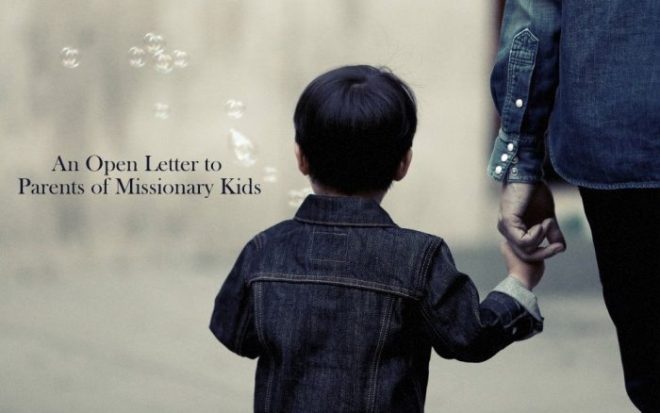
An Open Letter to Parents of Missionary Kids

13296061_10207991468477588_1266790338_na

By Danica Newton

Dear Parents of MKs,

Hello. It’s me, an MK. I write this on behalf of other MKs who haven’t found their voices yet, who are still in the midst of constant transition, who haven’t sorted through the confusing and complex joys and sorrows that come with growing up MK. I write this on behalf of my own MK self, to say the things I didn’t know to say, things that were buried deep down and that, as a kid, I could only access through intuition, through approaching carefully sideways in order not to stir up the vortex of emotions. I speak as an adult MK, raised with one foot in Polynesia, another in Melanesia, and a hand straddled all the way over the Pacific, planted firmly in Texas. If the world were a Twister mat, we MKs would be pros at maneuvering ourselves into epic contortions as we shift right-foot-yellow to left-hand-blue.

Parents of MKs, this is what I want you to know.

Transition causes trauma. We know this from academic research across fields. Transition because of divorce causes trauma. Transition because of health diagnoses causes trauma. Transition because of death causes trauma. Transitions from village to town every six months, and then to the States every few years, definitely causes trauma.

During the London Blitz, children were trundled off to the English countryside for their own safety. The philosophy of the time dictated that children were better off not knowing what was happening, that more information would be detrimental to them psychologically. In fact, some of the advice to parents was to tell their children that they were going on holiday to the country, or even, not to tell their children anything about what was to occur. This may have helped the adults not have to struggle to find explanations for the changes their children were experiencing, but it wasn’t helpful for the children experiencing the change. The problem with this way of approaching necessary transition, in short, is that it stems from the perspective and needs of the adults, the ones who already have power and control in the situation, the ones who already have a voice.

Parents of MKs, this is what I want you to know.

Your children are not experiencing the transitions you take them through in a vacuum. Just because they may not be verbalizing the trauma, or expressing it in ways that are easily understandable, does not mean they are not experiencing trauma from the transition. When I was sixteen, I stayed behind in Texas while my parents and younger siblings went back overseas. I remember that time as confusing and dark.  But years later, adults who were close to me at the time have told me things like: “You seemed so mature,”  “You handled it so well,”  and “We had no idea it was so hard for you, you seemed fine.”

I seemed fine because at that point I had spent the majority of my childhood in transition. Moving from village to town and back again. Moving from town to America. Moving from America back to town, back to village. Every transition required that I assume the cultural mores, dress, language, and customs of the place I was moving to. By the age of sixteen, I was an adept cultural chameleon. But how was I able to put on a new skin for each new place? I became an expert at compartmentalization. I carefully packed each place, with its friendships, food, smells, sights and sounds, into its own suitcase in my mind. Into the suitcases also went my feelings connected to the place. My love for the people. My pain at the heart bonds being broken. My anger at having no control. The compartmentalization is why I presented as so mature and well-adjusted to the adults around me.

Parents of MKs, this is what I want you to know.

Your MK may look like they are doing well.  Your MK may even say they are doing well. Please consider that your MK may be very adeptly doing just what MKs do best – assimilating the culture they are in. The culture that says all things happen for the good of those called according to His purpose. The culture that counts it joy when hardships are faced. The culture that counts everything as loss for the sake of following Christ. The culture that celebrates the leaving of father and mother, the leaving of brother and sister, to follow the Call.

Your MK may look like they are doing well. They may even say that they are doing well. But please consider how long they have been in transition. Consider that it’s only when we feel safe, when we have been stable and settled for an extended amount of time (for some, it takes years) before we can begin unpacking the suitcases and examining the emotions that were previously too difficult to process. If your MK moves every few months or years, they may still be in self-preservation mode. Like it was with me, they may not be able to examine the trauma of transition except by carefully looking sideways at it, from an emotional distance.

Parents of MKs, this is what I want you to know.

Your child needs you. They need you to listen, with no judgement or defensiveness, to their feelings. They need you to lay yourself low, to make yourself nothing for their sake, to humble yourself even to the point of death of self. They need you, as the person with all the power and voice, to create space for their fledgling voices. They need to be able to say, “This hurts me.” They need to be able to say, “I don’t want to leave.” They need to be able to say, “I miss _____.” They need to be able to mourn, to be angry, to rage against the dying of the light.

I’m going to say something now, Parents of MKs, that you probably don’t want to hear. But what I share with you, I share from my own experience, and from that experience I can reassure you that although this will be difficult to hear, there is hope for redemption.

My parents’ choices brought me pain. I didn’t know how much pain until I found myself, sobbing and unable to breathe, in the grips of powerful flashbacks that hit me out of nowhere and threw me in a little ball onto my bedroom floor. All of the goodbyes and hellos, the shifting and the changing, all of the transitions and the leavings, finally caught up with me.  This breakdown precipitated some conversations with my mom and dad, who are still on the mission field.  Conversations that had to wait until they could get to me. But once they got to me, my mom and dad presented me with the greatest gift they could give.

That gift was listening.  They listened to me, with a complete abandonment of self and agenda. I had years of loss to deal with, and my mom sat with me on my front porch, twin cups of coffee steaming in our hands, as I cried and talked and she cried and listened. She never once tried to justify her choices. She simply acknowledged my pain, and acknowledged that it was caused by the life she had chosen for me. My dad listened, too. We took long, cool walks through the expectant predawn stillness, him quietly receptive by my side as I poured out the pain in my heart. He apologized for the pain his choices had caused me.

I talked to God, too. My parents’ empathetic response to my pain opened space for me to be able to voice the very scariest thoughts that I kept buried deep, deep down. One day, heartsick and angry and alone, I looked up to God and shook my fist in his face. “Why, God?” I asked, tears sticky on my cheeks. “Why did my family have to suffer? Why did you make MY family suffer for YOUR gospel? Couldn’t it have been some other family? Why, God? Why MY family?”

As I sat, raw and trembling, I felt his warm, gentle touch. I heard him whisper so sadly and kindly to me, “I know. I’m sorry. I hear you. I’m here.” And that was enough.

Parents of MKs, this is what I want you to know. 

You need to check your defensiveness at the door. You need to acknowledge that your choices brought pain to your child.

When my parents came to me, and acknowledged the trauma my siblings and I had experienced, when they apologized for the pain they had caused, they did not negate the Good Work they have done. They did not negate a lifetime of service for the Kingdom of God.  They did not negate the fruit they had harvested for the King. Instead, they further confirmed Christ to us. The humble Man of Sorrows. The One who laid down His life. The One who sought out the voiceless, the weak, and lifted them up.

Even though your choices to answer the Call of Christ have caused trauma for your children, and believe me when I say that they have, your choices to give space for their pain can make way for their healing. I ask you, on behalf of my fellow MKs both grown and still growing, to give this gift to your child.

Sincerely,

Danica Newton

(an MK)

~~~~~~~~~~~~~~~~~~~~~~~~~~~~~~~~~

13161296_10156874097135022_561442390_oDanica is an MK from the Solomon Islands, who now has found her own little village in the mountains of New Mexico. She lives there with her husband and three children, three goats, two dogs, and an assortment of chickens. Danica has a degree in special education, and is currently working on a master’s degree. When she’s not writing papers for school, she enjoys playing mad scientist in her kitchen, rereading her collection of LM Montgomery books, and working on her yoga moves. Danica sometimes finds time to write about her experiences and feelings, at www.ramblingsofanundercovertck.blogspot.com.

Parents of Third Culture Kids, Failure, and Redefining Success

(revised from the original Who Wants Failure? on Djibouti Jones, written at the end of a year in Minnesota during which my husband worked on his PhD in Education Development)

TCKs and Failure

I opened the letter from my daughter’s first grade teacher and read it.

“Crap.” I wrinkled it into a tight ball, threw it in the garbage, and started crying.

She had tested into the gifted and talented program.

The parents of Third Culture Kids (at least me and at least sometimes) are probably the only parents in the world who want their kids to fail. At least while they are in their passport countries. If they fail here, it will be easier to go back there.

This is why I cried when my First Grade daughter, who should have only been in Kindergarten, easily passed into the Gifted and Talented Program at her American elementary school. It is why I cried when my son won first place trophies in wrestling tournaments and why I cried when my other daughter got her serves over the volleyball net.

There is no gifted and talented program where we live. There is no wresting team. There are no volleyball nets at school. There’s a French school where kids are trained to believe they are stupid, there’s wrestling but only with dad and the punching bag that hangs from the ceiling in the middle of our living room, and there aren’t girls sports, unless you consider dodging goats and donkey carts a sport.

So what do you do…No, how do you feel when these precious TCKs could stay in a country where they would have access to incredible resources and experiences and exposure? Just think what they could accomplish! Just imagine what opportunities they could have! How I could brag on Facebook!

But, in August they are going back to Africa.

Parents feel pain because it hurts to not be able to give good things to the people we love. Until we learn to redefine what those ‘good things’ are.

We feel confusion. Our children ache to go back to that place, the country that seems to steal so much from them, yet gives so much to them that they call it home. They don’t feel these losses because they have eyes to see the gains. They see the sweat, swimming with whale sharks, camping on the beach under the stars, hiking around active volcanoes and scrambling through lava tunnels, playing football (soccer) in the dirt yard with friends, dodging those donkey carts and goats. They love their friends, their school, their routines, and the traditions we have created.

And parents feel hope. Because wrestling trophies, volleyball games, and a certain definition of what makes a quality education aren’t the most important things. Loving people, engaging in the world, experiencing adventure, deep contentment, embracing diversity, and above all, delighting in God…these are the things that matter and these are the things that are happening in the lives of our TCKs.

It’s possible that if we lived in Minnesota, my children could succeed at all the events that make Instagram beautiful. But it is also possible that they wouldn’t. And, it is possible that they might succeed in other things, in other places.

My kids have literally seen a widow give her last two coins to a blind beggar. They have tucked food into the shirt pocket of Mohammed, who has no arms and stands outside the post office. They have prayed for and seen God heal friends with medical issues. They are learning to have courageous faith, to go against a crowd, to cross cultures. They live the reality that the pleasures of this world are not what satisfies.

Oh God! Hold them, keep them. May faith, may delighting in You alone, above all that America or our adoptive country have to offer, be their lifelong legacy of success.

How do you (and your kids) handle the losses and gains of parenting (and being) TCKs?

What Being a TCK is Really All About

hand-1008103_960_720a

We were sitting in a coffee shop having yet another one of those random conversations in which we could go from our favorite ramen noodle flavors to deep thoughts about our lives as TCKs.

My friend was explaining how blissful and easy her life had been before moving from Canada to Cambodia a year earlier. How her main ambitions had seemed so within her reach. How she had taken everything completely for granted. And then, how her family had suddenly moved to Asia.

I just sat and listened. As a TCK who had lived in Asia my whole life, it broke my heart to think about how she must have felt coming to Cambodia. And in that moment, my heart broke for all the third-culture-people out there, for all the confusion and heartbreak and loss they would feel in their lives. My heart broke for the tears they would shed and the pain that would come with every confusing moment, every tearful goodbye.

I didn’t really know what to say.

Then I realized something. “You’re never going to be normal, you know,” I said.

My friend gave one of her characteristic short laughs. “Yeah. I’m never going to be normal.”

*********

Third Culture Kids are never going to be normal.

Our life in Cambodia is far from normal. It is sweaty, smelly, and colorful. We’re always a hot mess. (And not in a cute way. At all.) Here, the classic four seasons are reduced to three: hot, very hot, and hot-and-raining. To have an amoeba is totally normal. And having Dengue fever more than once is not uncommon. Items on our bucket lists include tasting grilled dog meat and swimming across a polluted river.

Life is always an adventure. And life is hard sometimes.

There are hellos and goodbyes, which confront us almost on a monthly basis. “Home” is impossible to define. And figuring out who we are is even harder.

*********

“God doesn’t make mistakes, and He’s planned all along for us to live overseas.” We hear that a lot. Many people tell us that “our experiences will enrich us” or “we will gain so much from our cultural encounters.” We’ve even been told on numerous occasions that “it’ll be easier to get a job because we’ve lived overseas.”

While all of these things are true, and while we do appreciate that encouragement, we also want to say this: We don’t need you to feel sorry for us. We don’t need you to treat us a certain way. Or at least, that’s not the main point.

Sometimes the TCK journey is more about acceptance. There are so many people out there trying to understand us so that they can treat us the “right way” or make us feel better. But the TCK journey is so much more about a personal decision to accept ourselves the way we are. Being a TCK is about knowing we’re different and accepting that as a truly valuable thing.

It’s sort of like doing a puzzle. There comes a time when we struggle with defining “home” and doubt who we really are. We feel like there is only one “piece” that can fill the “home” space in the puzzle and that life is all about finding which piece fits in that gap. We also want to take out certain pieces of our life-picture as an attempt to let go of pain. We want to let go of people. We want to let go of places. We want to be able to replace pieces every time a change happens. But that doesn’t work.

Instead of trying in vain to remove important pieces from our life-puzzle, we need to understand that each piece is important. Essentially, TCK life is more about letting ourselves add pieces to our lives, accepting them equally, and choosing to allow them to live simultaneously with each other. It’s hard and messy and confusing, and we cry a lot. We know that. And it’s totally okay.

We don’t need to be so concerned about the puzzle pieces of our identity not fitting together perfectly. God has called us to find freedom in our true identities in Him. As TCKs, God has called us to experience these struggles for a specific purpose and has chosen to make them a part of who we are.

When we realize our special calling from God as His children (Ephesians 1:5) and find our identity in being his disciples, “the truth will set us free” (John 8:31-32). Our identity in God means that “home” is heaven (Philippians 3:20). We know that there is ultimately a purpose in each hard goodbye (Romans 8:28). We have hope (Ephesians 1:12) and peace (Ephesians 2:14), even when we feel like the future is too unknown or the past is too hard to handle.

Ultimately, the main point of the TCK journey is accepting our not-normal-ness. However hard it may be, it’s not about making the puzzle pieces fit. It’s about adopting a new perspective on our identity.

*****************************************


Sarah has lived her entire 18-year-old life in Southeast Asia. Originally Swiss, she speaks English with an American accent, German in a Swiss accent, and multiple other languages including Swiss-German, French, and Khmer. She loves Jane Austen, coffee, airplanes, and sentimental conversations about TCK life. 


Janelle is an 18-year-old TCK, MK, and PK who grew up in Canada before moving with her family to Asia just over two years ago. She is a lover of photography, passion fruit smoothies, OREOs, mountains, oceans, maxi skirts, and all things “Anne of Green Gables.”

10 Questions Missionary Kids Dread

Ever talked to an MK before? Did you wonder why we looked a little lost? Why we tend to give people confused looks all of the time? Yeah. As an MK myself, I can say with confidence: we’re an odd bunch. Guilty as charged! But there’s more to the story than you might think.

You see, MKs are usually asked many questions about our lives overseas. Although these well-intended questions are asked out of genuine friendliness, curiosity, and a desire to connect, a few can be extremely difficult to answer. Here are the top 10 questions MKs dread:

10 Questions MKs Dread Picture

Question #1“Aren’t you glad to be home?”

On the bright side, MKs have many homes we love dearly. On the not-so-bright side, MKs never know where home actually is. It’s complicated. Hence our blank expressions mixed with terror when confronted with this daunting question. Are we supposed to pick one? Do our homes across the ocean not count?

We are typically struck with this realization when ‘home’ assignment isn’t turning out how we envisioned. Permanently wrinkled clothes. Too many road trips in a ridiculously-short amount of time. A diet consisting mainly of the huge boxes of Wendy’s chicken nuggets purchased by sleep-deprived, currency-confused, mega-sized missionary families. Life is crazy. We recognize once again that our home country doesn’t feel like home anymore.


Question #2 “Do you remember me? I held you when you were 6 months old!”

Question #2 Baby Picture

MKs desperately want to avoid sounding rude, but our diaper-clad years are pretty vague. Especially when being held by 300 different people at eight different churches in five different states was our reality. Faces tend to blur after a while. Especially at six months old and/or long gaps between home-country visits.

Once, a dear older couple invited my family to their home for dinner. I none-too-geniously doubted I had ever met them. Then I saw our prayer card faithfully stuck on their fridge and blushed bright red. Oops.


Question #3 “Where do you buy your clothes?”

Missionaries aren’t usually applauded for their awesome fashion sense. But on occasion, we find ourselves accidentally wearing something not three years behind the current trend. I have these crazy-patterned bohemian pants I purchased in Chiang Mai at a night market. They’re faded and stretched, but they tend to attract attention. Once, a girl enthusiastically asked me where I purchased them.

“Thailand…”  I answered. She stared at me, alarmed by the fact that she would have to fly thirteen hours to purchase them. MKs’ wardrobes are usually furnished in more than one country (or even continent!) It happens.


Question #4 “How’s insert host country?”

Politically? Economically? Agriculturally? Socially? Spiritually? Personally? MKs have been asked all of the above! This is why I always try to avoid the professor-looking gentlemen with big glasses and grey sweaters at church visits. They are unfailingly interested in the population of Japan (my host country). I looked it up in preparation for my family’s last home assignment. But then I forgot.


Question #5 “Have you made a million friends?”

Well. Do my siblings count?

In truth, siblings are usually the only steady source of friendship MKs have. Chances are, we haven’t made a million friends in our host country. It’s painful to admit, especially when that is what’s expected of us. Language barriers and cultural differences make friendships difficult to bridge. Friendships with teammates are can end abruptly as families change location or ministry. Coupled with the realization that many of our former friends in our home country have moved on—most MKs are actually seeking friendships.


Question #6 “Can you say something in Chinese?

Yup. Chinese. Totally not dependent on what country we actually live in.


Question #7 “Don’t you love listening to your parent’s presentations?”

The first sixty times? Yes! Now? We hear them in our dreams. Seriously, no joke.

A few years ago, my family and I visited a friend’s small group to present about our ministry in Japan. My sister and I wanted to play outside. All the other kids wanted to listen to our parent’s presentation. We stared at them like they were crazy. Really?


Question #8 “Do you eat bugs?”

unnamed

This question wins the “most-frequently asked” award. Actually, I don’t eat bugs on a regular basis! But, yes, a lot of MKs do. I eat raw fish, squid, and octopus weekly, though. (That tends to still illicit the same response.)

Once, my friend went to a store in her host country to purchase a kitten. She picked the smallest, cutest, furriest one and handed it to the shop owner with her summer savings. He smiled, picked up the kitten, broke its neck, and gave it back to her in a paper bag for dinner. She ran home crying, “Mommy! Mommy! I didn’t want to eat Fluffy!”


Question #9 “Have you had fun over there?”

I love living overseas. But it is not a vacation! It’s life. Normal, mundane, regular life. Math tests, grocery-shopping, and room-cleaning still apply to MKs too. Just under different circumstances. Possibly without air-conditioning. Possibly without beds. Probably without a dryer.

But that’s okay. The only time I wished for a dryer was when I put on a freshly-washed shirt straight from the clothes rack and found a beetle crawling up my sleeve. I probably wouldn’t have categorized that experience as fun.   


Question #10 “Are you going to be a missionary when you grow up?”

What if someone asked you, “What’s your dad’s job? A doctor? Oh. Then you’re going to be a doctor too, right?”

“I don’t know!” you might reply.

I don’t know either. But I do know that I want to follow God’s call for my life, wherever that may be.


The next time you talk to an MK? Recognize they might feel lonely and insecure despite their nonchalant façade. Ask “how are you?” instead of “where are you from?” Give them a smile and a hug.

And to MKs, the next time you are asked one of these 10 questions? Smile. Recognize that they are asked out of a desire to understand and connect. Love back by engaging … even through these ever-dreaded questions.


Taylor Murray is a 17-year-old missionary kid serving with her family in Hiroshima, Japan. Author of Hidden in My Heart: A TCK’s Journey Through Cultural Transition, she is passionate about supporting TCKs and their families through her writing. Visit her blog at taylorjoyinwords.com.

Memories Of A Million Footsteps: How Our Secondary Homes Stick With Us

I am five months into our time in Port Vila now, and it’s been almost six months since Cyclone Pam devastated large parts of Vanuatu. All things considered, we’re settling in well. One thing that’s caught me by surprise during this move, however, is how much I think back to Laos. We spent five years there—three in Luang Prabang and two in Vientiane—and I didn’t realize just how deeply those five years had engraved Laos upon me until we were gone. Has that ever happened to you?

This month, in honor of the deeply important role that our secondary homes can have in shaping our lives, I want to share with you a piece I wrote almost a year ago now called Memories Of A Million Footsteps.

LPB 1

Last week we returned to Luang Prabang for the first time since we left here, more than a year ago. Those of you who have visited Luang Prabang will know what I mean when I say it’s a special place. Those of you who haven’t, imagine a small town nestled in between two rivers and cradled by jungle-covered mountains. Imagine grand and gilded temples alongside old-world French architecture. Imagine purple orchids and saffron-robed monks and sticky rice steaming in small bamboo baskets.

Boats on Mekong

We didn’t own a car during the three years we lived in Luang Prabang, so most evenings after Mike got home from work we would strike out on foot. Walking those streets for three years etched Luang Prabang into my internal map like no other place I have ever lived. It is maybe the only place in the world where you could drop me anywhere in town and I would know exactly where I was.

(Here, Mike would doubtless say that you would certainly hope so, given that the Old Town is entirely contained within three parallel roads, but that is beside the point.)

The point is that I know Luang Prabang. A million footsteps mapped it into me, and coming back was a sort of coming home.

Mike and I weathered some very difficult times during the years we lived in Luang Prabang – broken bones and medical emergencies, two spinal surgeries, depression, isolation, and post-natal anxiety. It was here that we both floundered in stormy internal seas during our first year as parents. It was here that we sometimes wondered whether those seas would swamp us completely.

But when I go back to Luang Prabang now I have to purposefully reach to pull those difficult times into view. As Mike and I walked around those familiar streets, it was all the good things about living there that flooded back – all the happy evenings and favorite restaurants and the lush, pervasive, and perfectly proportioned beauty of the place.

We timed this return visit to coincide with the annual Fire Lantern Festival that marks the end of Buddhist lent, so our first two nights here were lit by thousands of flickering candles that adorned the temples and the singular brilliance of hundreds of paper lanterns ascending from all over town into a still, dark sky.

We went back to our favorite waterfalls and we drank fresh lime juice by swimming pools. Waiters and market vendors remembered our names and did a double take to see red-headed baby number two in tow. We reconnected with old friends and we spent (too much?) money on beautiful silk scarves and wall hangings.

We remembered all over again that there have been many, many things that we have loved about our time here in Laos.  And that we were lucky to have lived in Luang Prabang for three of those years. And that even when times feel awfully thick and dark, future days can bring the hushed serenity of candlelight and the fierce brilliance of fire rising, rising, rising into the night.

LPB Lisa and Tash lighting lantern

What secondary homes have you lived in and then left?
How have they shaped you? What memories have stuck with you?

Particle Physics Finally Explains Third Culture Kids!

particle3

Some of you know I’m a science lover. Our friends back in the States know this too, and a couple times a year they send us a package with their old science magazines (along with other treats). I love Magazine Arrival Day.

Earlier this year I cracked open the September 2014 issue of Discover magazine and read about neutrinos – tiny, subatomic particles I don’t even pretend to understand. I’m a chemist, for goodness sake, not a physicist. My scientific understanding only goes down as small as protons and electrons, and not a quark smaller. Neutrinos are smaller than that, and also, extremely secretive.

As I read (largely uncomprehendingly) through the article, one particular section caught my attention, and I paused. Are we sure we’re talking about tiny subatomic particles here?? Because to me, this paragraph sounded more like the description of a fellow Third Culture Kid than anything else. Or, to enlarge the conversation a bit, it sounded like a Cross Cultural Kid (CCK) or Third Culture Adult (TCA) — terms I first read about in Lois Bushong’s insanely helpful Belonging Everywhere and Nowhere.

Check it out:

Neutrinos are notorious shape-shifters. Each one is born as one of three types, or flavors – electron, muon, and tau – but they can change flavors in a few thousandths of a second as they travel, as if they can’t make up their mind what to be. Neutrinos, like other subatomic particles, sometimes behave like waves. But as the neutrino travels, the flavor waves combine in different ways. Sometimes the combination forms what is mostly an electron neutrino and sometimes mostly a muon neutrino. Because neutrinos are quantum particles, and by definition weird, they are not one single flavor at a time, but rather always a mixture of flavors. On the very, very rare occasion that a neutrino interacts with another particle, if the reaction appears to produce an electron, then the neutrino was an electron flavor in its final moments; if it produces a muon, the neutrino was muon-flavored. It’s as if the shy neutrino’s identity crisis can only be resolved when it finally interacts with another particle.

So let’s break that down a bit and see if we can find any similarities:

  1. Neutrinos are shape-shifters. Or, as the TCK literature says, we are “cultural chameleons” who can shift between cultures and adapt to new ones more easily.
  2. Neutrinos can change flavors as they travel, as if they can’t make up their mind what to be. Again the chameleon quality is shining through. TCKs may have divided loyalties, and we might not want to choose one culture over another.
  3. Neutrinos are quantum particles and by definition, weird. TCKs often feel different from other people – “weird,” if you will. (And for me, that differentness has sometimes left me feeling lonely.)
  4. Neutrinos are not one single flavor at a time, but rather always a mixture of flavors. Likewise, TCKs aren’t one single culture or flavor; we’re a mixture.
  5. It’s as if the neutrino’s identity crisis can only be resolved when it interacts with another particle. Not only do we often struggle with identity crises – who am I?? – but TCKs can also be so good at adapting that we take on the culture of whatever people we most recently interacted with.


If you’re a TCK (or you love someone who is), did you find yourself or your loved one in any of these descriptions of the neutrino? Or am I just plain crazy to see this metaphor??

Do you have any other TCK metaphors? I’d love to hear about them in the comments!

       _

for a more contemplative TCK metaphor, click here

article and photo credit

One Down, Three to Go

I can remember when my wings sprouted and I longed to fly the coop. All I wanted was to be on my own and what I perceived to be free. I took any and every opportunity to do my own thing (for better or worse) and I’m not sure I even blinked when it was actually time to move out of the house and into the dorm.

I don’t remember my mom being sad. Maybe she was ready for me to go! Or maybe she is a more mature person than I and managed to hide herself in the bathroom and cry her eyes out when I couldn’t see. I’ll go for the latter.

Here I am sitting in Kijabe, Kenya, visiting the 3 boys and applying for school for my daughter, and I can’t get it out of my mind; the fact that this is my oldest son’s last mid-term break.

Ever.

I find myself staring at him, hanging on his words, making up stupid things to talk about just to keep the conversation going, fussing over him and desperate to hug and kiss him and say sweet things that only a mother can say to a son, all the while trying not to embarrass him too much.

Does he even know what it means for him to go? No.

But it is time and he is ready.

I’m pretty sure he will make some stupid mistakes along the way and may or may not tell me about them. He may even meet a girl and fall in love.

There goes my position as the most important woman in his life.

It’s just around the corner. The day I give him a kiss and a hug, say goodbye, tell him to be a good friend and work hard, and a zillion other bits of sage advice which I will try to cram into the last 30 seconds of seeing him. I’m pretty sure I will succeed in teaching him all of life’s lessons in the final minutes of my goodbye. It is a parent’s duty.

I watched him run off to class today and noticed that he is a breathtakingly beautiful man. I like who he has become. He is ready. It is time.

I can imagine drop-off day at the school. In my mind it’s an endless sea of moms sobbing through their goodbyes, heartbroken that their kids did the unexpected thing and grew up. It was kind of like that when we all deposited our children at boarding school. I have history with this.

During the bus ride home the sobbing moms will be acutely aware that they are in the same boat yet fully married to the attitude that no one understands. This is when I’ll stand up and say, “What are you all crying for? You’ll see your kid next weekend.”  (I’ve got a bit of pent up jealous anger for crying sad moms who will be living within driving distance of their college aged kids.)

And this is the true and honest question of mine; can I cope? Can I say goodbye to him full well knowing it could be a year… or more… until I see him again?

159687main_launch-l&l-lg

When I signed up to be a missionary, I did not sign up for this. I did not count the cost of children growing up and attending university. I did not foresee my son living on a different continent. I was sure that they would remain 10 years old forever, but here we are, just weeks from the day when he first sets foot onto the soil of adulthood, and we’ll be down one with three to go. Praying this thing gets easier before we send off the last, but just as soon as I say that, I remind myself that I never want it to be easy to release our children into adulthood.

I am worried. Worried that he’ll not just do stupid stuff, but do really, really stupid stuff. I’m worried that I’m wrong; that he’s not ready and he will need to come home with a failure ripping big holes into his heart. I’m worried that he’ll forget to call home and leave us desperate to know if he is dead or alive, happy or sad, thriving or … not.

Yah… I know. My spirituality and maturity rating just fell to zero, but there’s nothing rational about a mother’s love for her children. I guess I am no exception.

If you are on the same bus as me, sending your kids off this year, let’s make a deal. I won’t tell you I’ve got it much, much worse because I live in Africa and my son is moving to the U.S., but please, please don’t tell me how rough you have it when yours doesn’t want to come home until Thanksgiving.  I am insanely jealous.  In my better moments, I know this is irrational and surely there are moms who have it unspeakably worse than me, but honestly, it is where I am.

Instead, in a move toward motherhood solidarity, I’ll bring a box of tissues and we’ll share the common thread of missing mommy-hood and all the joys that having our kids at home brought us. We might even come to our senses and remember the countless ways our kids challenged us. (Err… made us seriously consider pediatric tranquilizers as a long-term solution.) We’ll replace the tears with laughter; the kind that makes your cheeks hurt and your sides ache. We’ll have a great old time with a glass of wine and celebrate each other for a job well done… children who not only want to fly the coop, but can FLY.

One down with three to go!


Previously published here.

photo credit


IMG_5505Jennifer Taylor is a married mother of four serving her second missionary assignment in Zambia.  She and her husband work with a local pastor and his wife in a community building effort in an under-served, semi-rural area.  She loves to write, learn, and teach and is a strong advocate for sustainable living.  To learn more about the Taylors, please visit, robandjennifer.wordpress.com.

The Psalms: A Reentry Handbook

By Robynn Bliss

I remember hanging suspended upside down inside a squished cab of a pick up truck alongside the road. The ambulance arrived, and two paramedics stuck their heads in from either side of the cab. They told us they would have us out in no time, they inquired as to how we were doing, and then they asked if there was anyone they could call for us. We grimaced and glanced at each other. Ethel had grown up in Brazil, Denise’s parents were in Nigeria, and mine remained obliviously out of reach in Pakistan. There was no one to call.

prhThe summer before I had watched, with that horrible sinking feeling, my parents board the plane to return to Pakistan. I was of age. I had crossed that dreaded line that meant that I no longer went with them. I was stuck in Canada, far from them, far from my childhood, far from everything I had ever known. I was alone.

It wasn’t entirely true. I wasn’t technically alone. My parents had figured out a plan for that first summer without them. I had people to stay with, a church to attend, and I knew where I would be going once summer was over. I had relatives that loved me. There were plenty of well-meaning people to look out for me, and yet deep inside there was a place that shook with the reality that I was really on my own.

I cried a lot that summer. I grieved adulthood thrust upon me. I ached for my parents and the stability they brought. I missed Pakistan and the familiar, my boarding school and all my chums. My loneliness was so profound it nearly swallowed me whole. It was thick and tangible.

During this time Jesus reminded me again of the Psalms.  David often was separated from his family, his friends, his safety, his childhood, his familiar. He was often on the run, living out of a suitcase: a transient, a wanderer (a TCK?). He was no stranger to separation and grief.  Many of his journal entries reflect that. He wrote things like: “Morning, noon, and night I cry out in my distress and the Lord hears my voice”(Ps 54:16), “You keep track of all my sorrows” (Ps 56:8), “Come with great power, O God and rescue me! (Ps 54:1), “for you have seen my troubles and you care about the anguish of my soul” (Ps 31:7).

In the midst of David’s pain and uncertainty he knew that God was his fortress and his protector, his helper.  He understood that God loved him deeply and that God was with him in the midst of all the sadness. “The Lord directs the steps of the godly. He delights in every detail of their lives. Thou they stumble, they will never fall for the Lord holds them by the hand” (Ps 37:23). ”Unfailing love surrounds those who trust the Lord” (Ps 32:10). I found comfort and camaraderie in reading David’s poems, his songs, his journal. He seemed to understand. He seemed confident that God would be with me too. It became my life line. During those first 2 years back I read nothing from scripture except the Psalms! David mentored me through reentry. He taught me how to depend on God in the midst of suffering and separation.

One day I was driving my little car across the Canadian prairie. Suddenly and for no apparent reason (I mean I wasn’t out of gas and there did appear to be oil in the car!), it quit! I had no idea what to do. I pulled to the side of the road and thought about my dad. My dad would know what to do! My dad had probably told me what to do at some point but I couldn’t remember what that was. And to complicate what always seemed already like a complicated life, my dad was off in Pakistan! I opened the hood and stood over it. The tears started running down my face. I felt the separation that was such a reality. And then I did what my mentor David taught me to do: I cried out to God. God if you are the Good Shepherd –the Expert on Sheep, and the Great Physician – the Expert on me…surely you know something about cars. Will you please come to my rescue? Will you please fix this stupid car?? I closed the hood, got back in behind the steering wheel and turned the key. It worked! God had fixed my car. God had been my Heavenly Mechanic, my Nearby Holy Dad. He had stepped in and helped me.

The reality of His nearness waxed and waned during those early years. Often God through His tender Spirit eased the pain of the separation and He was my helper! Other times it was still so very hard and I missed my parents and their expertise on living very keenly.

“O Lord you alone are my hope. I’ve trusted you, O Lord, from childhood. Yes, you have been with me… My life is an example to many, because you have been my strength and protection…. O God don’t stay away. My God, please hurry to help me… I will keep on hoping for your help. I will praise you more and more…. O God you have taught me from my earliest childhood, and I constantly tell others about the wonderful things you do…. Let me proclaim your power to this new generation, your mighty miracles to all who come after me…”Ps 71: 5-18


(Previously published on Communicating Across Boundaries and in Traveling Without Baggage, a Christar publication.)


Robynn Bliss is a proud Canadian who spent her childhood in Pakistan, married an American, and went on to live, work, and raise a family in India.  She is co-author of the book Expectations and Burnout:Women Surviving the Great Commission and writes at Communicating Across Boundaries every Friday.

The Little Word That Frees Us

We talk a lot about Missionary Kids (MKs) being Third Culture Kids (TCKs), but we talk less often about another aspect of their lives, the Preacher’s Kid (PKs) aspect. These MKs of ours, these kids we love so fiercely, are both TCKs and PKs. They deal with both the cultural issues of TCKs and the potential religious baggage of PKs. It’s the religious baggage that I want to talk about today.

venn1

(A nifty little visual to illustrate the intersection of TCKs and PKs in the souls of our MKs.)

Timothy L. Sanford, an adult MK and licensed professional counselor, wrote about some of the ramifications of growing up in ministry and missionary families in his book “I Have to be Perfect” (And Other Parsonage Heresies). To give you a bit of context for this little-known book, Ruth Van Reken, co-author of the classic Third Culture Kids book, both endorsed it and helped to edit it.

I’m not a PK or an MK, and I can never presume to speak for them. This book was, however, surprisingly relatable for me, and at times rather painful. Perhaps it’s because I entered ministry at age 19 — not still a child, not quite a woman. Perhaps it’s because I spent a few formative years in a highly legalistic church where everyone seemed to be on display.

Whatever the reason, I found I was susceptible to the lies addressed in this book. If I, without growing up in a ministry home, resonate with these PK issues, then maybe other missionaries and church workers do, too. I also know that many MKs and PKs end up serving overseas, and I began wondering if the ideas presented in this book have broader applications for the body of Christ.

While acknowledging the very special and unique lives PKs and MKs have lived, I also want to recognize that adults in ministry roles can absorb false ideas about themselves, about God, and about His people. And we all need truth and grace extended to us.

So this blog series is for all people in ministry contexts. Whether you grew up as a PK or an MK, whether you are currently or were formerly in overseas missions or local church ministry, or whether you’re married to someone who is, this blog series is for you. It’s also for the Church at large. If you are someone who cares about the walking wounded among us, this blog series is for you, too.

I believe, along with William Paul Young, that “since most of our hurts come through relationships, so will our healing.” Sometimes the Church gets stuck in damaging behavior patterns, and we, as a collective people, perpetuate beliefs in the lives of ministry families that simply aren’t true. Lies seep into our souls, and as a community we need to acknowledge them, wrestle with them, and ultimately, reject them – for there is a religious culture at work here that needs destroying.

I love the Church, and I believe one of the glorious reasons God places us in a local Body is so that we can “love each other deeply, from the heart,” and by so doing, participate in the healing of each other’s hearts. That is what these posts are about. Sharing our stories, and finding healing and wholeness together.

It is not about blaming parents or making anyone feel guilty. Rather, it is about mobilizing the Church to dismantle some of our harmful systems. It is about calling on Christians to change the way we do life together. Ministers, missionaries, and their families are the most notable casualties here, but the Body as a whole suffers when any member suffers. I believe we can be part of the healing.


_freedom__by_candymax-d1c7acla


But we need to do something first: we need to give ourselves permission to be honest. Before moving on to the lies PKs tend to believe, Timothy Sanford gives us permission to say the little word “and.” Saying “and” enables us to tell the rest of our story; it enables us to tell all our story.

This is where he caught my attention — because I had not given myself permission to say “and.” I had only been saying “but.” “And” is not the same as “but.” “But” tries to nullify, where “and” respects and includes. “But” attempts to cancel out the bad in our lives by focusing on the good, or to cancel out the good in our lives by focusing on the bad. The problem is, this doesn’t work. The negatives don’t nullify the positives, in anyone’s life. And the positives don’t nullify the negatives. Ever.

For some reason this concept was even more freeing than the yays and yucks I learned about in mission training. The good doesn’t mean the bad didn’t happen, but neither does the bad mean the good didn’t happen. They both happened. The question is, can I hold them both together, at the same time?

For a long time, I couldn’t hold them both together. I had thought it was disloyal to admit that my parents’ choices could ever cause me pain. But as a TCK in a military family, there was pain associated with our various relocations. There was good, and there was bad in our life. Just as there is good, and there is bad, in everyone’s lives. I needed permission to say so. I needed permission to say, “I had an idyllic childhood, AND all the goodbyes and hellos were painful.”

And perhaps you do too. Perhaps you need to know it is equally valid to talk about the negatives as well as the positives. Perhaps you need permission to break the silence you’ve been holding. Perhaps you need permission to say,

“My parents were good people, AND they did some bad things, too.”

“Our church (or agency) leadership loved us, AND they made decisions that hurt us, too.”

“I had some really neat experiences because of my parents’ jobs, AND there were some pretty awful experiences, too.”

Sometimes we just need permission to say these things.

Furthermore, when I read this book, I realized that I must also give that permission to my kids. The life my kids live because of my choices, it’s not all bad. And it’s not all good. (But neither would their life be, had I not gone into ministry, or not chosen to live overseas.)

Oh how I want to see life in black and white, as purely good or purely bad. But life is never black and white. And I learned I can’t take offense at the various things my kids might say were good or bad. I need to let them hold their own “ands.”

“But” is insufficient. We need to say “and.” This little word opens up a whole new life for us. And. Just breathe. In, and out. And then, tell the rest of the story, the rest of your story. Tell all of it together. Tell the entire thing, the parts that make you feel broken, and the parts that make you feel whole. Tell your ands.

Wherever you are in the world, it is my prayer that you will find people who can handle all the ands of your life.


What are the “ands” of your life? Are you being honest about them with yourself and with others? Or is there something you need to say that you’re not saying?

Perhaps the situation is reversed, and you need to hear someone else’s “and.” Are you willing to listen, even if it brings you pain?

Are our communities safe enough to tell the whole story of our lives? Are our communities safe enough for the “and”? Are we brave enough to listen to each other’s “ands”?


Bit by bit over the next few months, we will be processing the lies PKs & MKs (& the rest of us) tend to believe about people in ministry. As we delve deeper into these issues, I hope you will return each month to tell your stories and share your hearts, broken and otherwise, in the comments.

_

Part 2: “I’m Not Supposed to Have Needs“

Part 3: “I Can’t Trust Anyone“

Part 4: “God is Disappointed With Me“

Part 5: A Conversation with Timothy Sanford

photo credit

Creating Traditions Abroad

1917470_374541875602_974721_n

It may not be true for everyone reading, but many of us grew up celebrating Christmas in a certain way.  Part of the anticipation of the holiday season was wrapped up in the excitement of the traditions of the season.

Growing up, my little nuclear family of four used to get the fondue pot out every Christmas Eve. We would make an event of it and after dinner we cleaned up and headed to a candlelight service.  After church we were allowed to open one gift, saving the rest for the big-show Christmas morning.  Each year we went around the circle opening one gift at a time starting with the oldest family member and going around to the youngest.

Now a mom to seven children, I have not done as well as my parents did at creating traditions for my kids.  The main obstacle to creating tradition?  Living far from family and the places we learned and practiced our traditions.  Our family has been in Haiti for five of the eight celebrations that have happened since we moved, making it difficult to get any sort of traction on tradition making.

Each year we celebrate Christmas with different visitors to Haiti, we find ourselves facing unpredictable work schedules at the Maternity Center.  Traffic and uncertain political situations in the country change what we choose to do for Christmas Eve. All that to say, it can be fairly challenging to make a tradition in this environment.

We have succeeded at one singular new tradition, no matter where we find ourselves in the month of December.

The one thing we have done every year for eight years is create a little video production with our kids to give as a gift to our family and friends far away.  It started as a last minute idea in 2007, the year we were back in the USA having our last child. It has now become an annual tradition and we have the joy of seeing the kids change year to year in the  “Annual Christams Extravaganza”.  Our kids love watching the old ones and seeing how their voices and faces have changed.

Today I am curious what things you and yours have done to try to create traditions abroad in your new homes.

Have you come up with things that make it feel like Christmas even though you are far from those you typically celebrated with in the past?  

What new traditions have you created?


1917470_378019435602_5063213_n

1917470_374541885602_7406782_n

(The three photos in this post are from the 2009 Christmas production. Live animals for a nativity scene. Chocolate for bribing children.)

Find the Christmas rap of 2011 here. (Grown kids in Texas made an appearance too.)

Find 2012 here.